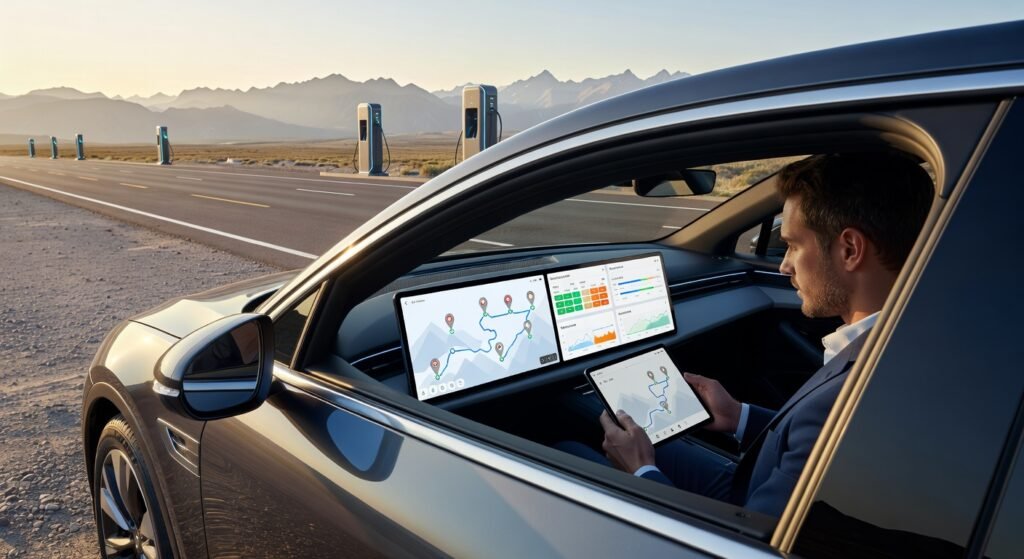
I used to think EV road tripping was equal parts adventure and anxiety. Range anxiety, charger hunting, surprise detours that kill your efficiency. Then I got serious about the right tools and everything changed. These five apps and platforms turned my electric adventures from stressful gambles into smooth, predictable, genuinely fun experiences.
Why Most EV Road Trip Planning Still Sucks
The dirty secret? Most people wing it with just Google Maps and hope. That’s a rookie mistake in 2025. The difference between a relaxing trip and one that leaves you stranded at a slow Level 2 charger for three hours comes down to using the right specialized tools in the right order.
ABRP (A Better Routeplanner) – The Undisputed King
ABRP isn’t just another planner. It’s the most sophisticated EV routing brain available. What makes it special is how deeply it models your specific vehicle. Enter your exact model, current battery percentage, temperature, wheel size, and even driving style, and it gives you scarily accurate predictions.
I’ve seen it adjust routes in real time when headwinds picked up or mountain grades drained the battery faster than expected. The live data integration with PlugShare and charger availability makes it feel almost psychic. This is the app I open first when planning any trip longer than 150 miles.
PlugShare – The Social Intelligence Layer
While ABRP excels at routing, PlugShare is the crowd-sourced heartbeat of the charging network. It’s where real EV drivers report broken chargers, long lines, or hidden gems before official apps catch up.
The comments section is pure gold. You’ll learn which chargers have rude attendants, which shopping centers actually let you park for free while charging, and which “24-hour” stations lock their bathrooms at 8pm. Think of PlugShare as the lively group chat for EV road trippers.
Tesla Trip Planner vs Everyone Else
Even if you don’t own a Tesla, their trip planner is worth studying. It’s elegantly simple because Tesla has perfect data on their own cars. The algorithm is conservative in the best way. It builds in buffer and suggests stops that feel natural rather than forced.
For non-Tesla owners, the lesson is clear: trust nothing completely. Cross-reference everything. Tesla’s planner, ABRP, and Google Maps EV mode all give slightly different answers. The magic happens when you understand why they disagree.
Google Maps EV Mode – The Silent Workhorse
Most people still don’t realize Google Maps has a dedicated EV routing mode now. It’s not as detailed as ABRP, but its integration with live traffic, construction, and general navigation makes it the perfect co-pilot.
I’ve started using Google Maps as the main navigation app while feeding it destinations that ABRP has already vetted. This combination gives you the best of both worlds: hyper-accurate energy predictions plus world-class turn-by-turn guidance.
The Real Secret: How to Combine Them Like a Pro
Here’s my exact workflow that’s been refined over 18,000 EV miles:
- Start in ABRP. Build the route with your exact vehicle profile and desired arrival battery percentage.
- Export the stops into PlugShare to check recent station reports and reliability.
- Import the major stops into Google Maps EV mode for final navigation.
- If driving a Tesla, run the same route through the in-car planner to see if it suggests anything different.
This layered approach removes 95% of the uncertainty. The remaining 5% is where the fun lives: spontaneous detours, hidden viewpoints, and unexpected conversations with other EV drivers at chargers.
The tools have matured. The infrastructure has improved dramatically. What hasn’t changed is the joy of traveling across the country knowing exactly how much energy you’ll have at every point in the journey.
The open road feels different when your car, your apps, and the charging network are finally speaking the same language.
Other EV Articles
- The EV Market is Splitting in Two – And That’s Actually Great News
- Why the Trump-Xi Summit Just Made Chinese EV Market Access a Much Bigger Problem
- QuantumScape’s $11M Q1 Billings: Why the Eagle Battery Just Changed the Game

- Toyota’s bZ4X Just Took the EV Crown – What It Really Means for the Future
- Uber’s $1.25 Billion Bet on Rivian Just Changed the Robotaxi Race
- Tesla’s Cybercab Production Just Started — And It Changes Everything
- Mitsubishi and Škoda Just Dropped Two Very Different EV Bombshells for 2026
- Kia’s Bold EV3 Gamble: Why This Compact SUV Could Redefine Affordable Electric Driving
- Lexus Just Dropped a Three-Row Electric SUV That Feels Like a Private Jet on Wheels

- Tesla’s Spring 2026 Update Just Changed the Game: Hey Grok and Smarter FSD Are Here
- Sony Honda Afeela 1: Why This Premium EV Could Redefine What “Luxury” Means in 2026
- Jeep’s 2026 Recon EV: The Wrangler’s Electric Twin That Might Actually Deliver Off-Road Fun

- Hino’s New LE Series Electric Truck Just Changed the Medium-Duty Game
- Why Polestar’s OEM Telematics Just Got a Whole Lot Smarter with Geotab

- BYD Just Overtook Tesla as the UK’s Top EV Brand – What This Really Means

Leave a Reply