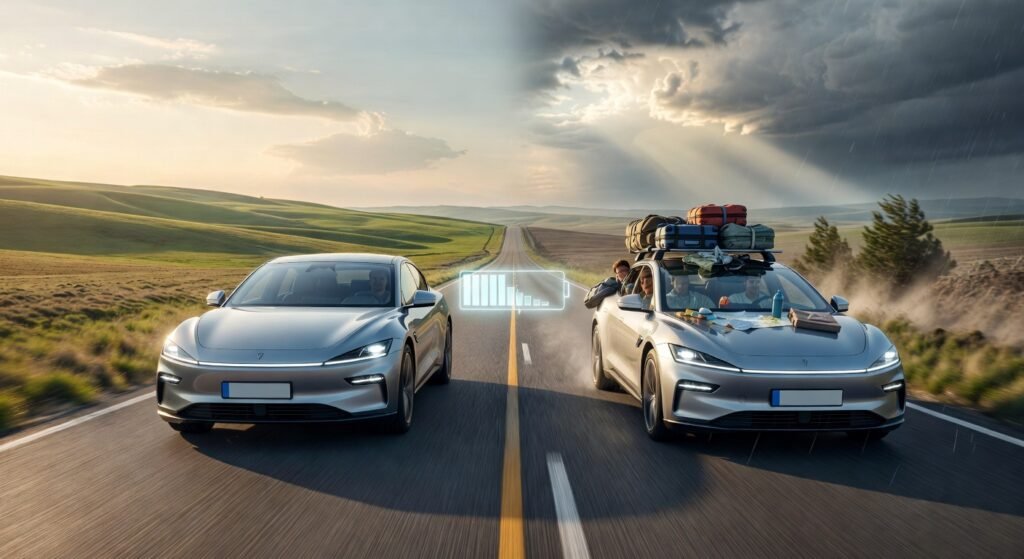
I just finished a 1,200-mile EV roadtrip that taught me one brutal truth: the number on the window sticker is basically a polite suggestion.
We’ve all seen the headlines about electric vehicles beating EPA estimates in certain conditions. What they don’t shout from the rooftops is how dramatically real-world highway range collapses when you’re actually trying to get somewhere. The difference between EPA’s lab numbers and what you’ll experience at 75 mph with a roof box and two kids in the back is shocking.
Highway Speed Is the Biggest Range Killer
The physics are merciless. aerodynamic drag increases with the square of your speed. That means going from 65 to 75 mph doesn’t cost you 15% more energy — it costs closer to 30-35%. On my recent trip from Denver to San Diego, dropping from 78 mph down to a disciplined 67 mph added nearly 70 miles of range per charge. The difference felt like unlocking a hidden battery.
Most drivers never experiment with this because slowing down feels like defeat. But here’s the contrarian truth: the fastest way to your destination in an EV is often driving slower than you want to. Fewer charging stops and less time spent at 350kW stations more than make up for the lower cruising speed.
Weather, Hills, and Cargo Don’t Negotiate
Cold weather is the silent assassin of EV roadtrips. Below freezing, range can drop 25-40% even on the highway. Heat isn’t much kinder when you’re running the AC at full blast across Texas in July. Then there are the mountains. Climbing from sea level to 7,000 feet in a single afternoon can drain your battery at double the normal rate.
Add a roof rack, bikes, or luggage and you’re introducing both weight and aerodynamic penalties. My normally efficient Tesla Model Y dropped from an observed 3.4 mi/kWh on flat highways to 2.1 mi/kWh when fully loaded crossing the Rockies. That’s not a small difference. That’s the difference between charging twice or charging four times on the same trip.
The Real-World Range Sweet Spot Most Owners Never Find
After multiple cross-country EV adventures, I’ve landed on a set of habits that consistently deliver 15-25% better efficiency than my early trips:
- Use Chill mode or the lowest power setting that still keeps you with traffic
- Precondition while plugged in at every stop
- Keep tires at the higher end of the recommended PSI (this one surprised me most)
- Draft behind semi-trucks when safe (yes, I said it — efficiency gains are real)
- Master the art of “momentum management” — using terrain to your advantage instead of fighting it
The drivers getting the best real-world numbers aren’t necessarily driving the most efficient cars. They’re the ones treating every trip like a strategy game where every mile per kWh counts.
What the EPA Tests Get Wrong About Highway Driving
The EPA’s highway test cycle tops out at 60 mph with very gentle acceleration and no payload. Real American highways look nothing like that. We drive faster, carry more stuff, and deal with real weather. The gap between official numbers and actual roadtrip reality explains why so many new EV owners feel betrayed by their first long drive.
Yet here’s the part that should excite you rather than discourage you: once you understand these variables, you can actually beat the EPA estimates in perfect conditions. I’ve done it multiple times on mild spring days with perfect elevation profiles. The car is capable. The variables just need to line up.
The future of roadtrips isn’t about pretending EVs already match gasoline convenience. It’s about getting smarter about when we leave, how we drive, and what we’re willing to adjust. The drivers who master this aren’t just saving money on fuel. They’re experiencing the quiet joy of gliding across the country knowing exactly how far their next charge will take them.
The open road still calls. It just whispers in kilowatt-hours now.
Other EV Articles
- The EV Market is Splitting in Two – And That’s Actually Great News
- Why the Trump-Xi Summit Just Made Chinese EV Market Access a Much Bigger Problem
- QuantumScape’s $11M Q1 Billings: Why the Eagle Battery Just Changed the Game

- Toyota’s bZ4X Just Took the EV Crown – What It Really Means for the Future
- Uber’s $1.25 Billion Bet on Rivian Just Changed the Robotaxi Race

- Tesla’s Cybercab Production Just Started — And It Changes Everything
- Mitsubishi and Škoda Just Dropped Two Very Different EV Bombshells for 2026
- Kia’s Bold EV3 Gamble: Why This Compact SUV Could Redefine Affordable Electric Driving
- Lexus Just Dropped a Three-Row Electric SUV That Feels Like a Private Jet on Wheels
- Tesla’s Spring 2026 Update Just Changed the Game: Hey Grok and Smarter FSD Are Here
- Sony Honda Afeela 1: Why This Premium EV Could Redefine What “Luxury” Means in 2026
- Jeep’s 2026 Recon EV: The Wrangler’s Electric Twin That Might Actually Deliver Off-Road Fun

- Hino’s New LE Series Electric Truck Just Changed the Medium-Duty Game
- Why Polestar’s OEM Telematics Just Got a Whole Lot Smarter with Geotab

- BYD Just Overtook Tesla as the UK’s Top EV Brand – What This Really Means

Leave a Reply