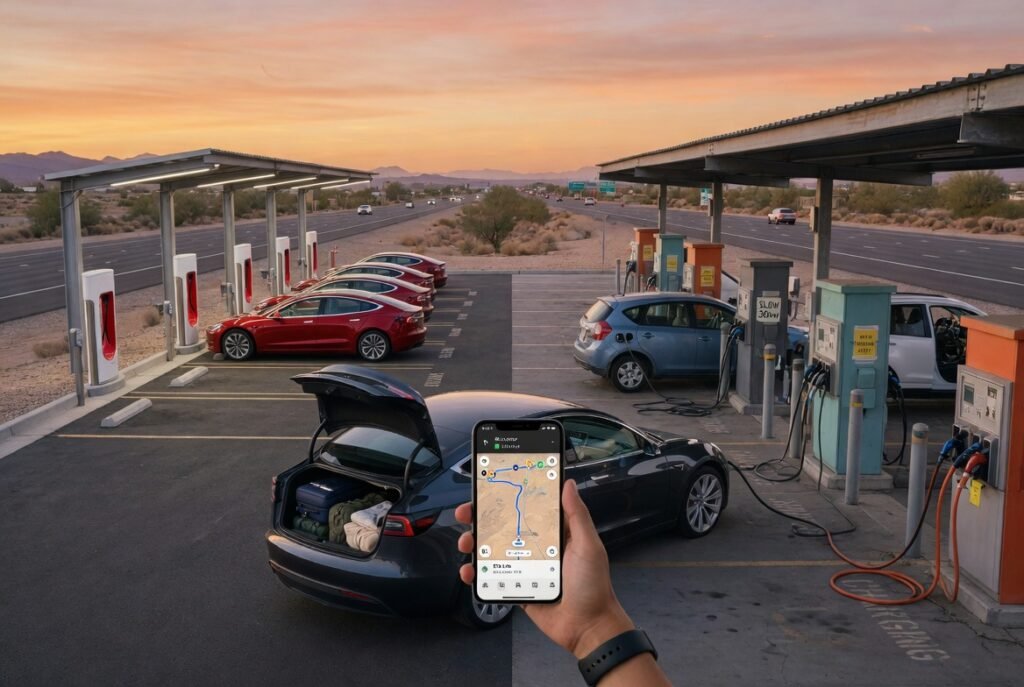
The golden age of EV road trips isn’t coming in some distant future. It’s arriving in 2026, and the rules have quietly changed. For years, Tesla owners enjoyed an almost unfair advantage with their Supercharger network. Today, that gap is closing faster than most people realize, creating exciting new strategies for anyone planning a long-distance electric adventure.
Tesla Superchargers vs Everyone Else: The 2026 Reality Check
Tesla’s Supercharger network remains the gold standard for reliability and speed. V4 stations routinely deliver 250 kW+ and the network’s uptime consistently beats competitors. But here’s what’s changed: non-Tesla EVs can now access the majority of Tesla Superchargers across North America. The once-closed kingdom has opened its gates, and the experience is surprisingly smooth.
That doesn’t mean every charging network is created equal. Electrify America has dramatically improved its reliability since its rocky early days, though it still trails Tesla in consistency on cross-country routes. EVgo, ChargePoint, and the growing number of independent operators each have sweet spots. The smartest road trippers in 2026 won’t pledge loyalty to any single brand. They’ll mix networks like a pro DJ mixes tracks.
The New Road Trip Strategy: Network Mixing Mastery
Successful 2026 EV road tripping is becoming less about finding “the best” network and more about understanding when to use each one. Tesla Superchargers still win for high-speed top-ups during peak travel hours and remote stretches. Other networks often offer lower pricing or better locations in cities and near popular attractions.
The real game-changer is planning with flexibility. Modern routing apps now show real-time reliability scores across networks. Savvy drivers build routes that use Tesla stations for the heavy lifting on long empty highways, then supplement with faster or cheaper alternatives where they make sense. This hybrid approach often delivers better total trip times and lower costs than relying on any single network.
What Actually Matters Most on the Road
Speed matters, but not as much as predictability. A slightly slower but always-working charger beats a 350kW stall that’s frequently offline. This is where Tesla still holds an edge, though the gap has narrowed considerably. Many experienced road trippers now report that a well-planned mixed-network route feels nearly as seamless as a pure Tesla trip, often at noticeably lower cost.
The environmental win is obvious. Every long-distance EV trip replaces gasoline with cleaner energy. The fiscal win comes from understanding that the cheapest kilowatt isn’t always the one with the lowest price per kWh. It’s the one that gets you back on the road fastest with the least stress.
The Future Feels Surprisingly Fun
Here’s the part that excites me most: EV road trips in 2026 are becoming more democratic. The technology that once felt exclusive now welcomes everyone willing to learn a few new habits. The anxiety that defined early EV travel is being replaced by something better, a sense of playful exploration backed by increasingly robust infrastructure.
The road trip itself, that quintessential American experience, is getting an electric upgrade that feels more liberating than limiting. Different networks, different speeds, different pricing models all become part of the adventure rather than obstacles to it.
The drivers who will enjoy 2026 the most aren’t the ones hunting for perfection. They’re the ones who embrace the mix, stay curious about new stations, and treat charging stops as part of the journey instead of necessary evils.
The open road is calling. This time, it’s electric, it’s improving rapidly, and it’s more accessible than ever before.
Other EV Articles
- The EV Market is Splitting in Two – And That’s Actually Great News
- Why the Trump-Xi Summit Just Made Chinese EV Market Access a Much Bigger Problem
- QuantumScape’s $11M Q1 Billings: Why the Eagle Battery Just Changed the Game

- Toyota’s bZ4X Just Took the EV Crown – What It Really Means for the Future
- Uber’s $1.25 Billion Bet on Rivian Just Changed the Robotaxi Race
- Tesla’s Cybercab Production Just Started — And It Changes Everything
- Mitsubishi and Škoda Just Dropped Two Very Different EV Bombshells for 2026
- Kia’s Bold EV3 Gamble: Why This Compact SUV Could Redefine Affordable Electric Driving
- Lexus Just Dropped a Three-Row Electric SUV That Feels Like a Private Jet on Wheels
- Tesla’s Spring 2026 Update Just Changed the Game: Hey Grok and Smarter FSD Are Here
- Sony Honda Afeela 1: Why This Premium EV Could Redefine What “Luxury” Means in 2026
- Jeep’s 2026 Recon EV: The Wrangler’s Electric Twin That Might Actually Deliver Off-Road Fun
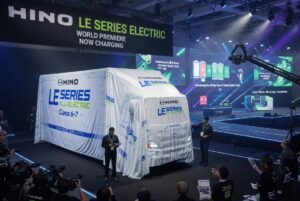
- Hino’s New LE Series Electric Truck Just Changed the Medium-Duty Game
- Why Polestar’s OEM Telematics Just Got a Whole Lot Smarter with Geotab

- BYD Just Overtook Tesla as the UK’s Top EV Brand – What This Really Means

Leave a Reply