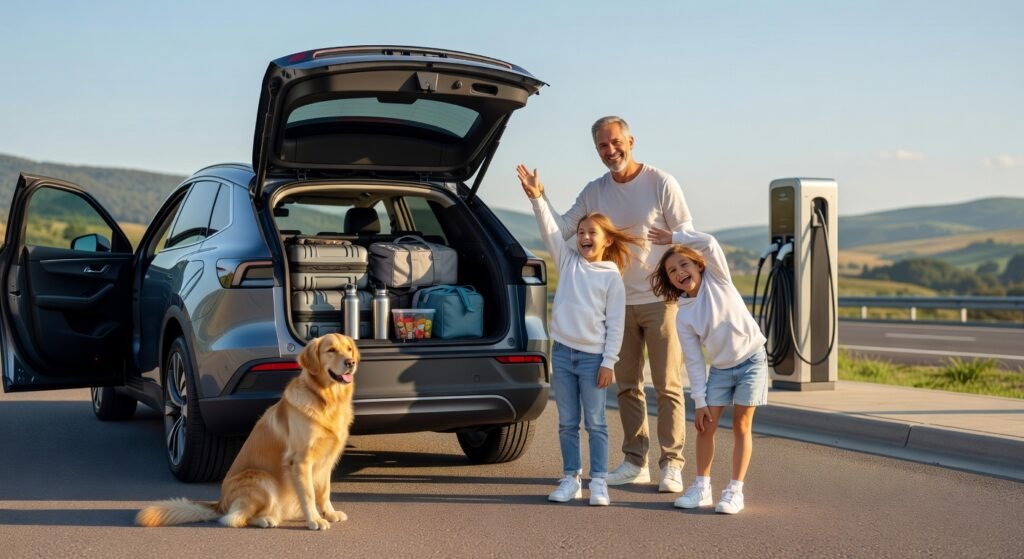
The open road has never felt more alive than when you’re behind the wheel of an electric vehicle with the whole crew—kids, dogs, snacks, and zero guilt about the carbon footprint. What used to be a noisy, gas-guzzling ordeal has quietly become one of the most civilized ways to travel as a family. The secret isn’t just the silent ride or the instant torque. It’s learning how to turn charging stops into the best parts of the journey.
Modern EVs have changed the math on family travel. Yes, range anxiety is real, but it fades fast once you realize that 30-to-45-minute charging sessions are actually perfect for resetting everyone’s mood. Instead of rushing through a ten-minute gas stop, you now have built-in pauses that work in your favor—especially when traveling with children and pets who need to burn off energy.
Turn Charging Time Into Family Reset Time
The smartest EV families I know stopped fighting the charge schedule and started designing around it. A 40-minute stop at a well-equipped station becomes snack time, stretch time, and fetch time all in one. Kids race around safe, open areas while the dog gets a proper walk. Everyone returns to the car calmer, happier, and ready for the next leg.
Look for chargers near parks, pet-friendly trails, or interesting small-town squares. Some of the best road trip memories happen during these intentional pauses. The surprise bonus? You see parts of the country most highway drivers completely miss.
Pet-Friendly EV Travel: Comfort and Safety First
Dogs and EVs are a surprisingly good match. The lack of engine noise keeps most pets calmer, and the flat, spacious cargo areas in models like the Tesla Model Y, Rivian R1S, or VW ID.Buzz make perfect dog lounges. Bring a familiar blanket, a portable fan that clips onto the vent, and a collapsible water bowl that lives in the door pocket.
Never leave pets in a locked car during charging, even with preconditioning. Instead, take them with you. Many newer charging hubs now offer shaded seating or grass patches specifically because so many travelers now roll up with four-legged copilots. Pack a harness that doubles as a seat-belt tether for safety during the drive—sudden EV acceleration can surprise even well-behaved dogs.
Keeping Kids Happy When the Battery Hits 20%
Children and charging stops require strategy. Pack a “charge bag” filled with activities that only come out during those stops: special snacks, travel journals, binoculars for spotting license plates, or a cheap drone for open fields. The predictability of the next stop actually reduces the classic “Are we there yet?” complaints because everyone knows when the next adventure break is coming.
Rotate seating positions at every charge. The kid who had the worst view gets the best seat for the next segment. Small wins like this keep morale high across long days. And don’t underestimate the power of letting them pick the next charger’s location on the map. Giving them ownership turns logistics into a game.
The Contrarian Truth Most People Miss
Here’s what nobody says out loud: EV road trips with family force you to slow down in the best possible way. You can’t hammer 700 miles in a day like you can in a gas car. That limitation becomes a feature. You see more sunsets, eat at more local spots, and create deeper memories because the car itself demands you respect everyone’s comfort—including the dog’s.
The fiscal side is equally compelling. Even with today’s electricity rates, most families save several hundred dollars per cross-country trip compared to gasoline. Those savings conveniently fund better hotels, nicer meals, or souvenirs that actually matter.
The road ahead is electric, and it turns out it’s also more family-friendly than we expected. The vehicles are quieter, the stops are longer but richer, and the entire experience leaves everyone—including the planet—in better shape.
Slow down. Charge up. Let the kids and dogs run. The best family stories aren’t written at 80 miles per hour. They’re written while you’re waiting for that last 20 percent.
Other EV Articles
- The EV Market is Splitting in Two – And That’s Actually Great News
- Why the Trump-Xi Summit Just Made Chinese EV Market Access a Much Bigger Problem
- QuantumScape’s $11M Q1 Billings: Why the Eagle Battery Just Changed the Game

- Toyota’s bZ4X Just Took the EV Crown – What It Really Means for the Future
- Uber’s $1.25 Billion Bet on Rivian Just Changed the Robotaxi Race
- Tesla’s Cybercab Production Just Started — And It Changes Everything
- Mitsubishi and Škoda Just Dropped Two Very Different EV Bombshells for 2026
- Kia’s Bold EV3 Gamble: Why This Compact SUV Could Redefine Affordable Electric Driving
- Lexus Just Dropped a Three-Row Electric SUV That Feels Like a Private Jet on Wheels
- Tesla’s Spring 2026 Update Just Changed the Game: Hey Grok and Smarter FSD Are Here
- Sony Honda Afeela 1: Why This Premium EV Could Redefine What “Luxury” Means in 2026
- Jeep’s 2026 Recon EV: The Wrangler’s Electric Twin That Might Actually Deliver Off-Road Fun

- Hino’s New LE Series Electric Truck Just Changed the Medium-Duty Game
- Why Polestar’s OEM Telematics Just Got a Whole Lot Smarter with Geotab

- BYD Just Overtook Tesla as the UK’s Top EV Brand – What This Really Means

Leave a Reply