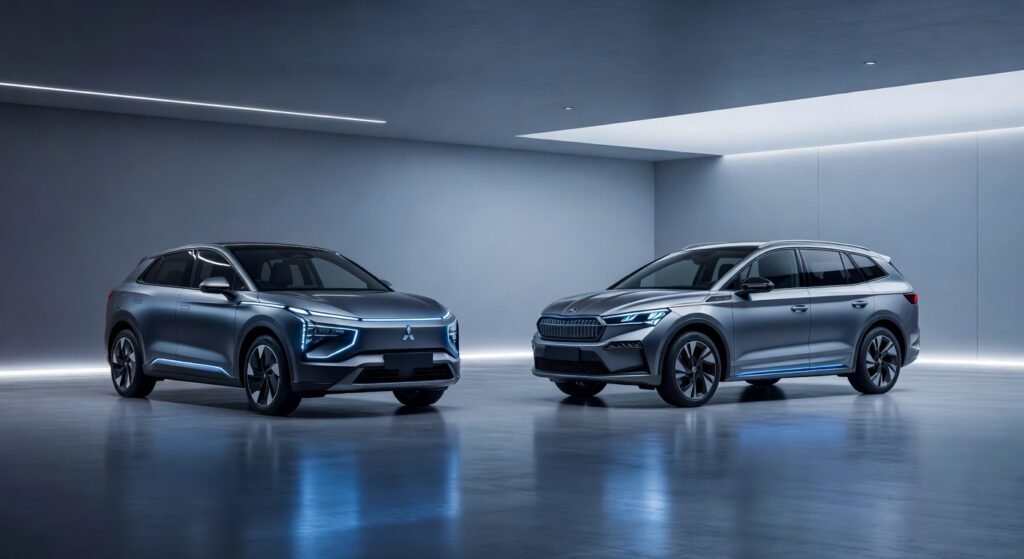
The EV industry never sleeps, and this week delivered two reminders that the game is shifting faster than most people realize. While legacy automakers are still figuring out how to make money on electric cars, Mitsubishi and Škoda just quietly sketched very different paths forward. One is playing it safe and familiar. The other is swinging for the fences with something genuinely new. Both moves matter more than they first appear.
Mitsubishi’s Low-Risk, High-Recognition Play
Mitsubishi confirmed it will launch a new battery-electric vehicle in summer 2026. Details remain scarce, but the company’s history suggests this won’t be a moonshot. Expect a practical, reliable crossover built on proven platforms, likely sharing technology with its Nissan and Renault alliance partners.
For Mitsubishi, this is smart positioning. The brand has loyal customers who value dependability over flash. By arriving in 2026 with a competitive but not revolutionary product, Mitsubishi avoids the bleeding-edge costs that have hurt other manufacturers. It also gives the company time to watch how battery prices, charging infrastructure, and consumer sentiment evolve before committing to riskier designs. In an industry littered with expensive flops, playing the long game can be surprisingly aggressive.
Škoda’s Bold Flagship Statement
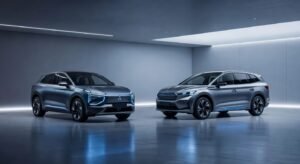
At the opposite end of the spectrum sits Škoda’s upcoming Peaq flagship. This is no rebadged platform mate. The Czech brand is preparing a large, premium electric vehicle designed to stand on its own and challenge established luxury names.
The Peaq represents something refreshing: a mainstream manufacturer choosing to stretch its engineering muscle instead of playing it safe. By aiming higher, Škoda is betting that enough buyers want space, presence, and character without paying full German luxury tax. If executed well, this could become one of the most interesting large EVs of the late 2020s.
Why These Two Launches Reveal the Real EV Crossroads
What makes these announcements fascinating is how clearly they illustrate the fork in the road facing every carmaker today. Mitsubishi is optimizing for survival and steady profits. Škoda is optimizing for differentiation and brand elevation. Both strategies can work, but they require completely different mindsets, budgets, and tolerances for risk.
The industry is moving past the “everyone must go all-electric immediately” panic phase. We’re now entering the more mature, and frankly more interesting, period where companies must decide who they actually are. Not every brand needs to build a 1,000-horsepower halo car. And not every brand should play it entirely safe either.
What This Means for Buyers and the Planet
For consumers, this diversity is excellent news. The coming years should deliver more choice at more price points than the current sea of similar-looking crossovers. Environmentally conscious drivers who are also fiscally responsible finally get options that don’t require choosing between virtue and financial common sense.
Mitsubishi’s practical approach will likely deliver strong value and real-world efficiency. Škoda’s flagship ambitions could push design boundaries and force competitors to raise their game. When both succeed in their own lanes, the entire industry moves forward without forcing every company into the same unsustainable template.
The next few years will show which philosophy scales better. But one thing already feels clear: the winners won’t be the companies that simply copied everyone else. They’ll be the ones that understood their own customers deeply enough to build something that actually fits.
The EV revolution isn’t a single straight line. It’s a collection of smart, sometimes contradictory bets. Mitsubishi and Škoda just placed two of the more intriguing ones.
Other EV Articles
- The EV Market is Splitting in Two – And That’s Actually Great News
- Why the Trump-Xi Summit Just Made Chinese EV Market Access a Much Bigger Problem
- QuantumScape’s $11M Q1 Billings: Why the Eagle Battery Just Changed the Game

- Toyota’s bZ4X Just Took the EV Crown – What It Really Means for the Future
- Uber’s $1.25 Billion Bet on Rivian Just Changed the Robotaxi Race
- Tesla’s Cybercab Production Just Started — And It Changes Everything
- Mitsubishi and Škoda Just Dropped Two Very Different EV Bombshells for 2026
- Kia’s Bold EV3 Gamble: Why This Compact SUV Could Redefine Affordable Electric Driving
- Lexus Just Dropped a Three-Row Electric SUV That Feels Like a Private Jet on Wheels
- Tesla’s Spring 2026 Update Just Changed the Game: Hey Grok and Smarter FSD Are Here
- Sony Honda Afeela 1: Why This Premium EV Could Redefine What “Luxury” Means in 2026
- Jeep’s 2026 Recon EV: The Wrangler’s Electric Twin That Might Actually Deliver Off-Road Fun
- Hino’s New LE Series Electric Truck Just Changed the Medium-Duty Game
- Why Polestar’s OEM Telematics Just Got a Whole Lot Smarter with Geotab

- BYD Just Overtook Tesla as the UK’s Top EV Brand – What This Really Means

Leave a Reply