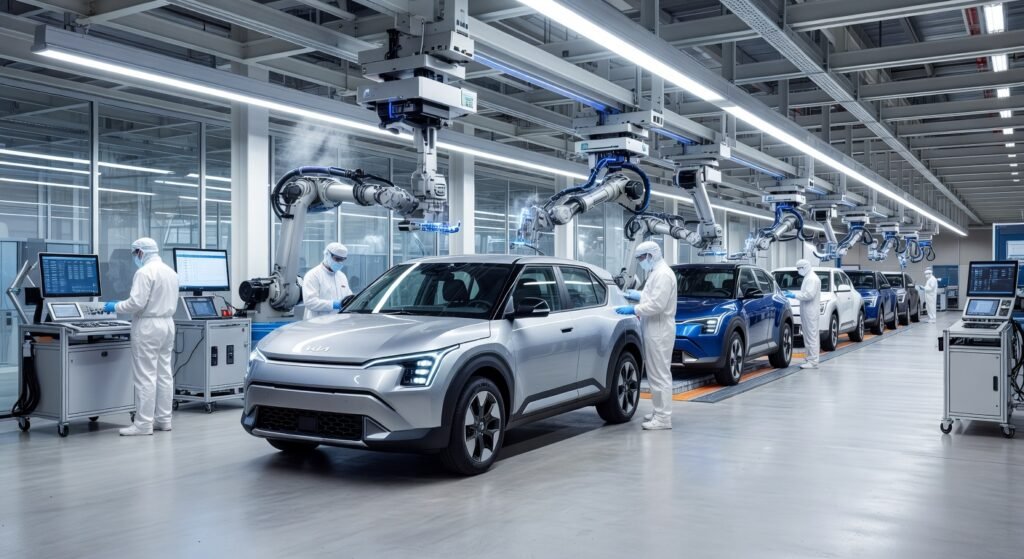
The European EV market is about to get a serious reality check. While legacy automakers wrestle with slowing demand and sky-high prices, Kia is preparing to launch the EV2 – a compact, affordable electric vehicle specifically engineered for European tastes, budgets, and city streets. This isn’t just another EV rollout. It’s a calculated move that could reshape how millions of Europeans think about going electric.
For years, the conversation around EVs has centered on luxury models with premium pricing. Kia is flipping that script. The EV2 is expected to start under €30,000, making it one of the most accessible battery-electric vehicles to hit the continent. That price point isn’t an accident. It’s a direct response to what actual buyers have been asking for: an EV that doesn’t require a second mortgage.
Smart Design Meets European Reality
Looking at early details from Kia’s development, the EV2 adopts a clean, boxy aesthetic that maximizes interior space while keeping a small footprint. Think practical hatchback proportions with surprising rear legroom and a usable boot. This matters in cities like Paris, Berlin, and Madrid where parking is tight and every centimeter counts.
The platform underneath is equally clever. Built on an evolved version of Kia’s E-GMP architecture, the EV2 promises competitive range for daily commuting – likely between 250 and 300 miles on a full charge. Fast charging capability will let drivers add meaningful range during a quick coffee stop. These aren’t headline-grabbing specs, but they’re exactly the practical numbers that drive real adoption.
Timing Everything in a Shifting Market
The launch timing feels almost perfect. Many European countries are adjusting or slowing their EV incentives, leaving buyers more price-sensitive than ever. At the same time, stricter emissions regulations continue pushing fleets and private owners toward electrification. Kia is positioning the EV2 right in the middle of that tension – affordable enough to work without heavy subsidies yet compliant with future rules.
What makes this especially interesting is Kia’s manufacturing strategy. By producing the EV2 in Europe, the company avoids potential import tariffs and reduces supply chain vulnerabilities. This local production approach also allows faster response to customer feedback and regional preferences, something Asian manufacturers have historically struggled with.
The Real Impact on Competition
Here’s the contrarian truth most analysts are missing: the biggest threat to established European brands might not come from Tesla or Chinese upstarts, but from value-driven Korean manufacturers like Kia and Hyundai. The EV2 arrives at a moment when many buyers feel priced out of the current electric offerings. If Kia nails the execution, the ripple effects could force competitors to reconsider their own pricing strategies.
The model also signals a maturing EV industry. We’re moving beyond the early adopter phase into mainstream practicality. Success for the EV2 won’t be measured in viral social media moments but in steady sales to families, young professionals, and small business owners who simply need reliable, low-cost transportation.
What This Means for the Future of Electric Mobility
The EV2 represents more than one car. It’s proof that electric vehicles can be both environmentally responsible and fiscally sensible. In an era where sustainability and household budgets often feel at odds, that balance is revolutionary.
Kia has quietly built a reputation for overdelivering on value while pushing design boundaries. The EV2 seems poised to continue that tradition in the electric space. If the final product matches the promise, we could be looking at one of the most significant vehicles of the decade – not because it’s the fastest or most luxurious, but because it makes electric driving accessible to the people who need it most.
The European streets are about to get a lot more interesting.
Other EV Articles
- The EV Market is Splitting in Two – And That’s Actually Great News
- Why the Trump-Xi Summit Just Made Chinese EV Market Access a Much Bigger Problem
- QuantumScape’s $11M Q1 Billings: Why the Eagle Battery Just Changed the Game

- Toyota’s bZ4X Just Took the EV Crown – What It Really Means for the Future
- Uber’s $1.25 Billion Bet on Rivian Just Changed the Robotaxi Race
- Tesla’s Cybercab Production Just Started — And It Changes Everything
- Mitsubishi and Škoda Just Dropped Two Very Different EV Bombshells for 2026
- Kia’s Bold EV3 Gamble: Why This Compact SUV Could Redefine Affordable Electric Driving
- Lexus Just Dropped a Three-Row Electric SUV That Feels Like a Private Jet on Wheels
- Tesla’s Spring 2026 Update Just Changed the Game: Hey Grok and Smarter FSD Are Here
- Sony Honda Afeela 1: Why This Premium EV Could Redefine What “Luxury” Means in 2026
- Jeep’s 2026 Recon EV: The Wrangler’s Electric Twin That Might Actually Deliver Off-Road Fun

- Hino’s New LE Series Electric Truck Just Changed the Medium-Duty Game
- Why Polestar’s OEM Telematics Just Got a Whole Lot Smarter with Geotab

- BYD Just Overtook Tesla as the UK’s Top EV Brand – What This Really Means

Leave a Reply