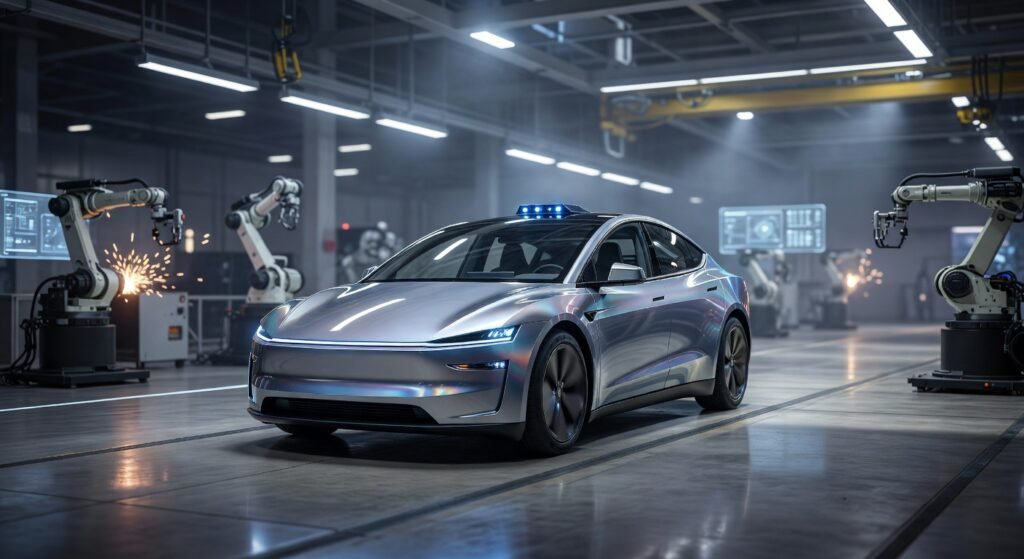
The moment many have been waiting for is finally here. Tesla has officially kicked off production of the Cybercab, its sleek, driverless Robotaxi designed from the ground up for an autonomous future. What once felt like a distant promise from Elon Musk now has steel, wheels, and a factory line moving behind it. This isn’t another concept render. It’s real metal heading toward real roads.
For years, critics dismissed Tesla’s autonomous ambitions as overpromising. The Cybercab’s official production launch proves the bet is maturing faster than most expected. With a vehicle stripped of everything unnecessary — no steering wheel, no pedals, radically simplified manufacturing — Tesla is attacking the economics of transportation at its core. The goal is simple but revolutionary: deliver mobility cheaper than car ownership while generating new revenue streams for owners.
Why the Cybercab Looks and Feels Different
This isn’t a modified Model Y or a rebadged EV. The Cybercab was engineered exclusively for unsupervised self-driving. Its low-slung, two-seater design prioritizes efficiency, passenger comfort, and minimal production cost. Early footage shows a vehicle that looks more like a futuristic pod than a traditional car, with gull-wing doors and an interior focused entirely on the rider experience.
What surprises many is how quickly Tesla moved from unveiling the Cybercab in October 2024 to actual production. While competitors continue pouring billions into incremental driver-assistance systems, Tesla has doubled down on its vision-only approach. The bet appears to be paying off as production tooling now runs in preparation for scaled output.
The Environmental and Economic Angle Most People Miss
Here’s where it gets interesting for those who care about both sustainability and smart money. A fully utilized Robotaxi fleet could slash the number of vehicles needed in cities by up to 80 percent according to several independent studies. Fewer cars sitting idle 96 percent of the time means dramatically lower resource consumption — less steel, lithium, cobalt, and manufacturing energy required overall.
At the same time, owners who add their personal Cybercabs to the Tesla network could earn meaningful income while the vehicle works. This flips the traditional car from a depreciating asset into a potential cash-flow generator. For environmentally conscious yet fiscally responsible people, that combination is hard to ignore.
The Road Ahead Won’t Be Smooth — And That’s Okay
Let’s be honest. Regulatory approval for unsupervised robotaxis remains the biggest variable. Different states and countries move at different speeds. Tesla will need to prove safety data at scale before widespread deployment. Yet the company’s decision to begin production now signals confidence that the technical hurdles are largely solved and that regulatory conversations are progressing.
The real surprise may be how fast consumer behavior shifts once reliable, low-cost autonomous rides become available in multiple cities. Young people already show declining interest in car ownership. When an electric Robotaxi can arrive in minutes and cost less than owning, insuring, and parking a personal vehicle, the transportation math changes for millions.
What This Means for the Next Decade
Tesla’s move into volume Cybercab production marks a pivotal shift from electric vehicles to autonomous transportation as the company’s primary growth driver. The implications stretch far beyond one automaker. Entire industries — insurance, urban planning, energy infrastructure, even retail real estate — will feel the ripple effects.
This isn’t just about Tesla having another cool product. It’s about accelerating a future where transportation becomes a service rather than a possession. For those paying attention, the official start of Cybercab production feels less like a product launch and more like the opening scene of a completely new economic chapter.
The coming years will separate the hype from the reality. But one thing is already clear: the autonomous era just moved from PowerPoint slides into an actual factory. And the world is about to look very different because of it.
Other EV Articles
- The EV Market is Splitting in Two – And That’s Actually Great News
- Why the Trump-Xi Summit Just Made Chinese EV Market Access a Much Bigger Problem
- QuantumScape’s $11M Q1 Billings: Why the Eagle Battery Just Changed the Game
- Toyota’s bZ4X Just Took the EV Crown – What It Really Means for the Future
- Uber’s $1.25 Billion Bet on Rivian Just Changed the Robotaxi Race
- Tesla’s Cybercab Production Just Started — And It Changes Everything
- Mitsubishi and Škoda Just Dropped Two Very Different EV Bombshells for 2026
- Kia’s Bold EV3 Gamble: Why This Compact SUV Could Redefine Affordable Electric Driving
- Lexus Just Dropped a Three-Row Electric SUV That Feels Like a Private Jet on Wheels
- Tesla’s Spring 2026 Update Just Changed the Game: Hey Grok and Smarter FSD Are Here
- Sony Honda Afeela 1: Why This Premium EV Could Redefine What “Luxury” Means in 2026
- Jeep’s 2026 Recon EV: The Wrangler’s Electric Twin That Might Actually Deliver Off-Road Fun

- Hino’s New LE Series Electric Truck Just Changed the Medium-Duty Game
- Why Polestar’s OEM Telematics Just Got a Whole Lot Smarter with Geotab

- BYD Just Overtook Tesla as the UK’s Top EV Brand – What This Really Means

Leave a Reply