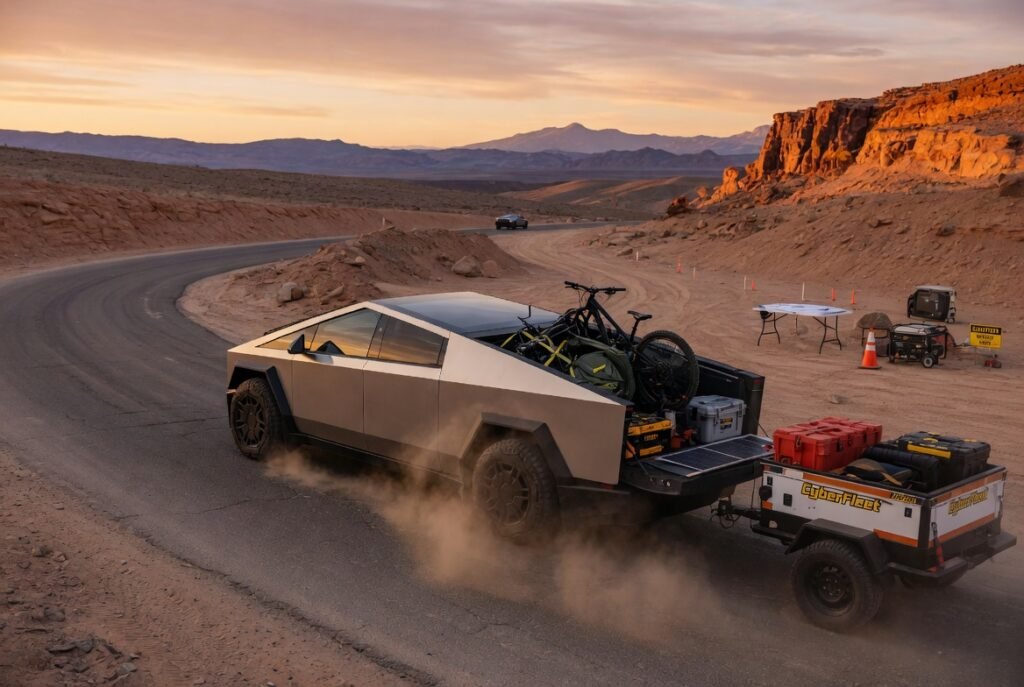
The moment I hit the highway with 1,800 pounds of gear in the Cybertruck bed and a small trailer behind it, I realized this wasn’t going to be another polished EV press drive. This was going to be honest — the kind of trip that separates marketing claims from actual fleet reality.
The plan was simple but ambitious: travel from Southern California through the Sierras, hit a few remote trailheads, tow equipment to a job site in Nevada, and use the truck itself as a mobile power station for tools. No chase vehicles. No safety net. Just the truck, real loads, and whatever the road threw at us.
Range Reality When You Actually Use a Truck
The first surprise came fast. Heavily loaded and towing, the Cybertruck’s efficiency dropped exactly as physics demands. What usually looks like 300+ miles of range on paper settled into a very usable 160–190 miles between charges once we factored in elevation, headwinds, and the trailer.
That number isn’t disappointing — it’s clarifying. For anyone running a field crew or mobile business, it means you simply plan your day around 170-mile segments instead of winging it. The truck never left us stranded, but it forced better routing discipline than a diesel ever did.
Off-Road Detours That Changed the Game
Where the Cybertruck truly started to shine was when we left pavement. A last-minute decision to scout an old mining road outside Mammoth turned into one of the most fun and useful days of the trip. The truck’s four-wheel steering and adaptive air suspension made easy work of rocky two-tracks that would have rattled a conventional truck.
Even more impressive was pulling off to the side of the trail, dropping the tailgate, and running a full set of power tools straight from the truck’s 120-volt and 240-volt outlets. No generator. No fuel cans. Just plug in the circular saw, the air compressor, or the laptop and keep working. For contractors or film crews who live in the field, this single feature rewrites the logistics of a workday.
Towing Without the Traditional Headache
Towing with an EV still feels slightly surreal. There’s massive low-end torque available instantly, which makes pulling a loaded trailer up mountain grades smoother than expected. The trade-off is obvious — range shrinks — but the driving experience is calmer. No gear hunting. No wondering if the transmission is stressed. The truck simply delivers power.
We towed everything from photography gear and camping equipment to a small utility trailer filled with tools. Each time we stopped to charge, the 800-volt architecture brought the battery back to 80% faster than most competitors, keeping the whole operation on schedule.
The Fleet Angle Nobody Talks About
This is where the Cybertruck starts looking less like a rich guy’s toy and more like legitimate fleet equipment. Construction teams, event producers, backcountry guides, and mobile service businesses all share the same need: a vehicle that can haul, tow, crawl, and power tools without requiring a separate generator or fuel truck.
Watching the truck silently power a job site while also serving as transportation made the economics click. You’re eliminating fuel costs, generator maintenance, and one entire support vehicle from the equation. Over thousands of miles a year, those savings become serious.
The trip also revealed something unexpected. Because the truck is so capable in so many directions — highway cruiser, off-road explorer, mobile workstation — it reduces the number of specialized vehicles a small team actually needs. That kind of consolidation matters when you’re watching every line on a P&L.
By the time we rolled back into California, the Cybertruck had proven it can handle the chaotic mix of real work and adventure that defines modern mobile operations. It isn’t perfect. Range still requires planning. Charging infrastructure in remote areas is still sparse. But the combination of capability, silence, and built-in power generation creates something genuinely new.
The road trip didn’t just test a truck. It tested an emerging way of working — one where your vehicle becomes an active part of the job instead of just transportation to it.
And that future feels closer than most people realize.
Other EV Articles
- The EV Market is Splitting in Two – And That’s Actually Great News
- Why the Trump-Xi Summit Just Made Chinese EV Market Access a Much Bigger Problem
- QuantumScape’s $11M Q1 Billings: Why the Eagle Battery Just Changed the Game

- Toyota’s bZ4X Just Took the EV Crown – What It Really Means for the Future

- Uber’s $1.25 Billion Bet on Rivian Just Changed the Robotaxi Race

- Tesla’s Cybercab Production Just Started — And It Changes Everything
- Mitsubishi and Škoda Just Dropped Two Very Different EV Bombshells for 2026

- Kia’s Bold EV3 Gamble: Why This Compact SUV Could Redefine Affordable Electric Driving

- Lexus Just Dropped a Three-Row Electric SUV That Feels Like a Private Jet on Wheels

- Tesla’s Spring 2026 Update Just Changed the Game: Hey Grok and Smarter FSD Are Here
- Sony Honda Afeela 1: Why This Premium EV Could Redefine What “Luxury” Means in 2026
- Jeep’s 2026 Recon EV: The Wrangler’s Electric Twin That Might Actually Deliver Off-Road Fun

- Hino’s New LE Series Electric Truck Just Changed the Medium-Duty Game
- Why Polestar’s OEM Telematics Just Got a Whole Lot Smarter with Geotab

- BYD Just Overtook Tesla as the UK’s Top EV Brand – What This Really Means


Leave a Reply