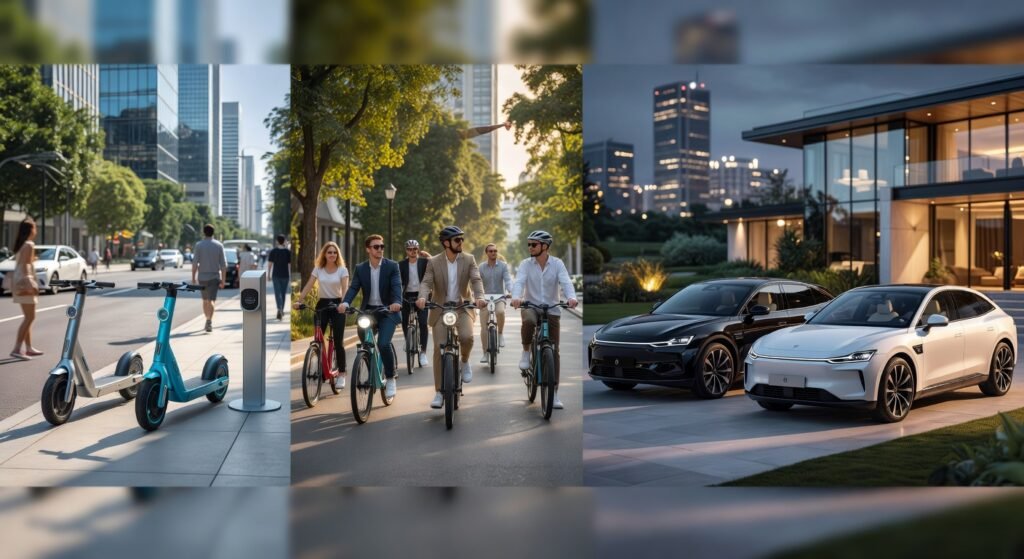
The electric vehicle world isn’t just growing. It’s fracturing. On one end you have cheeky, affordable electric scooters zipping through city traffic for the price of a decent mountain bike. On the other, six-figure luxury SUVs that can out-accelerate most supercars while silently gliding down the highway. Between them sits a widening gap that most buyers are only now noticing.
This isn’t chaos. It’s healthy market evolution.
For years we assumed EVs would follow the path of smartphones: start expensive, then rapidly democratize. Reality has proven more interesting. Instead of one smooth curve, we’re seeing two distinct tribes form. Budget-conscious buyers are snapping up nimble, practical machines that solve real daily problems. Meanwhile, affluent early adopters are treating EVs as performance and status platforms, happily paying premiums for blistering acceleration, lavish interiors, and cutting-edge tech.
The numbers tell the story clearly. Entry-level electric two-wheelers and compact cars are seeing explosive growth in Asia and Europe, driven by rising fuel prices, urban congestion, and improving battery economics. At the same time, luxury brands are reporting record order books for vehicles that cost more than many people’s homes. The middle, interestingly, is proving trickier.
Why the Middle Market Feels Stuck
The uncomfortable truth is that the “sensible family EV” priced between $35,000 and $55,000 remains surprisingly hard to find. Range anxiety, charging infrastructure gaps, and high battery costs have kept many mainstream models either too expensive or too compromised. Meanwhile, the scooters and luxury segments solved their specific equations brilliantly.
Scooter makers focused on simplicity, low weight, and urban practicality. Luxury brands doubled down on emotion, performance, and brand prestige. Both approaches work because they stopped trying to be everything to everyone.
This fragmentation creates unexpected opportunities. Cities are quietly becoming laboratories for new mobility mixes. Young professionals who once dreamed of owning a Tesla now happily combine an electric scooter for commuting with occasional rideshares or rentals for longer trips. The math simply makes more sense.
What This Split Means for the Next Decade
The real winners won’t necessarily be the companies trying to straddle both worlds. They’ll be the ones who pick their lane and dominate it completely. We’re already seeing specialized players emerge who understand that an affordable electric scooter and a $120,000 performance SUV solve completely different human needs.
Environmental impact adds another fascinating layer. While luxury EV owners get most of the media attention, the cumulative carbon reduction from millions of electric two-wheelers in dense Asian cities may actually move the needle faster in the short term. Different tools, same mission.
The beauty of this fragmentation is that it reflects reality rather than forcing one-size-fits-all solutions. Not everyone needs 300 miles of range. Not everyone cares about 0-60 in under three seconds. Some just want cheap, reliable, silent transportation that doesn’t pollute their neighborhood.
Smart buyers are already adapting.
They’re mixing and matching solutions instead of waiting for the perfect all-in-one vehicle that may never arrive at an acceptable price. One electric scooter for daily use, a long-range EV for road trips, and public transit or rentals to fill the gaps. It’s pragmatic, fiscal, and surprisingly fun.
The EV revolution isn’t failing to deliver on its early promises. It’s simply delivering in more creative, segmented ways than we expected. And that might be exactly what accelerates adoption in the long run.
The market isn’t broken. It’s branching. The question is which branch makes the most sense for your life right now.
Other EV Articles
- The EV Market is Splitting in Two – And That’s Actually Great News
- Why the Trump-Xi Summit Just Made Chinese EV Market Access a Much Bigger Problem
- QuantumScape’s $11M Q1 Billings: Why the Eagle Battery Just Changed the Game

- Toyota’s bZ4X Just Took the EV Crown – What It Really Means for the Future
- Uber’s $1.25 Billion Bet on Rivian Just Changed the Robotaxi Race
- Tesla’s Cybercab Production Just Started — And It Changes Everything
- Mitsubishi and Škoda Just Dropped Two Very Different EV Bombshells for 2026
- Kia’s Bold EV3 Gamble: Why This Compact SUV Could Redefine Affordable Electric Driving
- Lexus Just Dropped a Three-Row Electric SUV That Feels Like a Private Jet on Wheels
- Tesla’s Spring 2026 Update Just Changed the Game: Hey Grok and Smarter FSD Are Here
- Sony Honda Afeela 1: Why This Premium EV Could Redefine What “Luxury” Means in 2026
- Jeep’s 2026 Recon EV: The Wrangler’s Electric Twin That Might Actually Deliver Off-Road Fun

- Hino’s New LE Series Electric Truck Just Changed the Medium-Duty Game
- Why Polestar’s OEM Telematics Just Got a Whole Lot Smarter with Geotab

- BYD Just Overtook Tesla as the UK’s Top EV Brand – What This Really Means

Leave a Reply