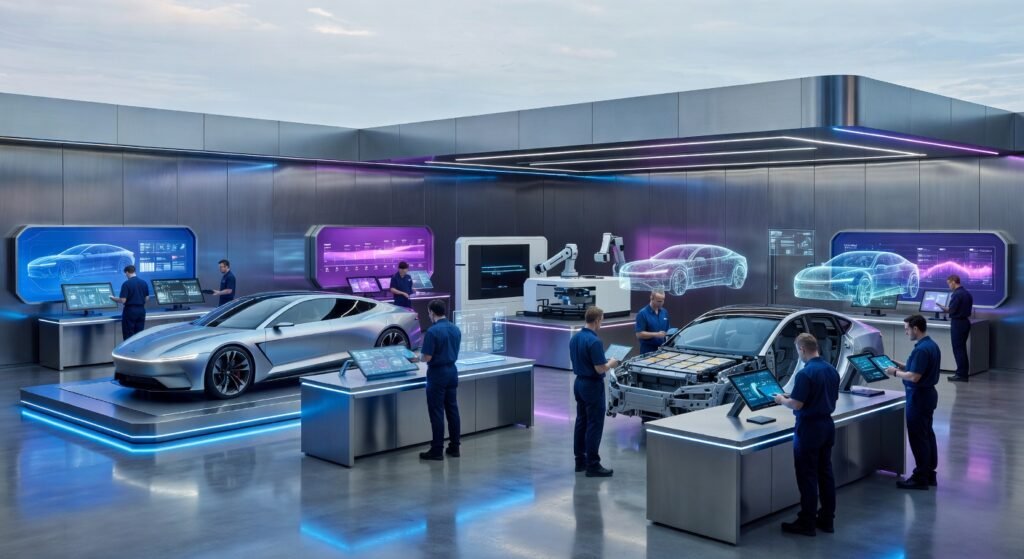
While Detroit still makes headlines with quarterly sales reports, a small team in Long Beach is working on something far more interesting. Ford’s West Coast Skunk Works isn’t another corporate innovation theater. It’s a lean, deliberately low-profile outfit where engineers tinker with ideas that could actually move the electric vehicle industry forward without the usual bureaucracy.
This isn’t marketing spin. The group operates with the freedom once reserved for defense contractors, focused on rapid experimentation rather than endless PowerPoint reviews. Their mission is simple on paper, revolutionary in practice: compress development timelines, test radical concepts, and deliver meaningful breakthroughs that traditional automotive programs can’t touch.
Why Location Matters More Than Most Admit
Long Beach gives Ford something its Michigan headquarters never could: proximity to talent that doesn’t speak “car guy.” Software engineers from SpaceX, battery experts from Southern California’s clean-tech scene, and user-experience designers who grew up thinking Tesla was old news all work within a short drive. The cultural distance from Dearborn is intentional and powerful.
The team isn’t trying to out-Tesla Tesla on range or horsepower. Instead, they’re asking sharper questions: How do you make an EV that feels joyful again? How do you solve real owner frustrations that surveys keep missing? What does sustainable performance look like when you stop copying yesterday’s playbook?
The Hidden Advantage of Staying Quiet
By staying under the radar, Ford’s skunk works avoids the pressure-cooker expectations that crush most automotive innovation efforts. No viral concept cars. No premature promises. Just steady, serious work on charging behavior, thermal systems, materials, and software experiences that could quietly reshape what drivers expect from their next vehicle.
This approach stands in refreshing contrast to the industry’s habit of over-promising and under-delivering on timelines. While other automakers announce moonshot platforms they won’t deliver for seven years, the Long Beach team measures progress in months, not model years.
What This Means for the Future of Electric Vehicles
The real story isn’t that Ford has a secret lab. It’s that legacy automakers are finally learning they need secret labs. The pace of technological change in batteries, power electronics, and AI-driven vehicle behavior now moves too fast for traditional development cycles.
Ford’s experiment suggests a new model: keep the scale and manufacturing muscle of a century-old company, but create protected spaces where small teams can think and move like startups. Get the ideas right first, then hand them off to the larger organization for execution.
This hybrid approach might be the most practical path forward for responsible EV adoption. It balances bold innovation with fiscal discipline and environmental seriousness without theater.
The auto industry has spent years talking about disruption. Ford’s West Coast operation is doing something better. It’s quietly building it.
The most exciting breakthroughs often happen when nobody’s watching. If the Long Beach team succeeds, the first time most people will hear about their work is when it shows up in a vehicle they actually want to buy.
And that might be the smartest innovation strategy of all.
Other EV Articles
- The EV Market is Splitting in Two – And That’s Actually Great News
- Why the Trump-Xi Summit Just Made Chinese EV Market Access a Much Bigger Problem
- QuantumScape’s $11M Q1 Billings: Why the Eagle Battery Just Changed the Game
- Toyota’s bZ4X Just Took the EV Crown – What It Really Means for the Future
- Uber’s $1.25 Billion Bet on Rivian Just Changed the Robotaxi Race
- Tesla’s Cybercab Production Just Started — And It Changes Everything
- Mitsubishi and Škoda Just Dropped Two Very Different EV Bombshells for 2026
- Kia’s Bold EV3 Gamble: Why This Compact SUV Could Redefine Affordable Electric Driving
- Lexus Just Dropped a Three-Row Electric SUV That Feels Like a Private Jet on Wheels
- Tesla’s Spring 2026 Update Just Changed the Game: Hey Grok and Smarter FSD Are Here
- Sony Honda Afeela 1: Why This Premium EV Could Redefine What “Luxury” Means in 2026
- Jeep’s 2026 Recon EV: The Wrangler’s Electric Twin That Might Actually Deliver Off-Road Fun
- Hino’s New LE Series Electric Truck Just Changed the Medium-Duty Game
- Why Polestar’s OEM Telematics Just Got a Whole Lot Smarter with Geotab

- BYD Just Overtook Tesla as the UK’s Top EV Brand – What This Really Means

Leave a Reply