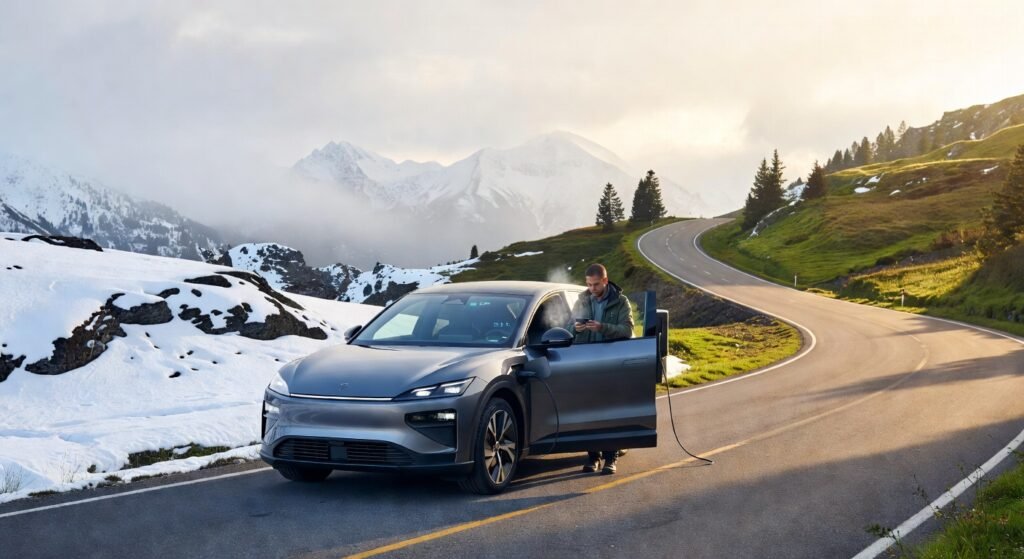
The open road in an EV feels like freedom itself — until the temperature drops, the mountains loom, or summer heat turns your battery into a nervous wreck. Seasonal EV road trip tips aren’t just nice-to-know trivia. They’re the difference between arriving with 40% battery and limping into a charger praying you don’t get stranded.
I’ve learned this the hard way after years of testing EVs in every condition. Cold weather battery drain is brutal, yet surprisingly manageable once you stop treating your car like a gasoline sedan. Heat management matters just as much in summer. And those glorious mountain drives? They’ll quietly eat range faster than you expect if you’re not prepared.
Mastering Winter EV Range Without the Panic
Cold is the silent killer of EV road trips. Below freezing, your battery can lose 20-40% of its effective range. The heater is the biggest culprit — it pulls massive power compared to a gas car’s waste heat. The fix isn’t suffering in the cold. It’s smart preconditioning. Warm the car while it’s still plugged in. Use seat heaters instead of cabin heat. Keep speeds steady on the highway. These small habits can easily add 30-50 miles of real-world winter range.
Don’t forget tire pressure. Cold air shrinks it fast, and underinflated tires destroy efficiency. Check before every long leg. Also, remember that regenerative braking weakens in extreme cold. Plan your stops with that in mind instead of assuming you’ll recapture energy on every downhill.
Summer Heat: The Range Thief You Ignore
Most drivers obsess over winter but underestimate how summer heat affects lithium-ion batteries. When cabin temperatures soar, the car works overtime to cool both the battery pack and the interior. Aggressive air conditioning can cut range by 15-25%.
The smarter play is using departure preconditioning while plugged in, parking in shade whenever possible, and keeping windows tinted. On long summer EV road trips, moderate your speed. The difference between 65 and 75 mph in 95-degree heat is often 20-30 miles of range. Small choices compound dramatically when you’re hours from the next fast charger.
Mountain Driving: Elevation Changes That Surprise EV Owners
Nothing tests an EV like serious elevation. Climbing mountains can slash your displayed range by half in real time. The good news? You usually get most of that energy back on the descent through regenerative braking. The secret is planning around the climb, not the average.
Drive conservatively uphill. Use eco mode. Keep an eye on battery temperature — sustained high loads in hot weather can trigger temporary power limits. On the way down, let regen do the heavy lifting. Many experienced EV road trippers actually arrive at the top of a pass with less battery than they expected but leave the descent with more than when they started the climb.
The Real Strategy Smart EV Road Trippers Use
The best EV road trip advice isn’t flashy. It’s boringly consistent: precondition, moderate speed, watch the weather, and understand your specific car’s behavior in different conditions. The drivers who enjoy these trips most treat range as a puzzle, not a limitation.
They know winter EV range performance improves dramatically with preparation. They respect summer heat management. They respect what elevation does to efficiency. Most importantly, they stay curious instead of frustrated when the numbers on the screen change.
The future of road trips is electric. Those who master these seasonal realities aren’t just saving money on fuel — they’re having more fun, creating better stories, and traveling with clearer environmental and financial conscience.
The road is waiting. Just make sure your EV strategy is ready for whatever season throws at it.
Other EV Articles
- The EV Market is Splitting in Two – And That’s Actually Great News
- Why the Trump-Xi Summit Just Made Chinese EV Market Access a Much Bigger Problem
- QuantumScape’s $11M Q1 Billings: Why the Eagle Battery Just Changed the Game

- Toyota’s bZ4X Just Took the EV Crown – What It Really Means for the Future
- Uber’s $1.25 Billion Bet on Rivian Just Changed the Robotaxi Race
- Tesla’s Cybercab Production Just Started — And It Changes Everything
- Mitsubishi and Škoda Just Dropped Two Very Different EV Bombshells for 2026
- Kia’s Bold EV3 Gamble: Why This Compact SUV Could Redefine Affordable Electric Driving
- Lexus Just Dropped a Three-Row Electric SUV That Feels Like a Private Jet on Wheels
- Tesla’s Spring 2026 Update Just Changed the Game: Hey Grok and Smarter FSD Are Here
- Sony Honda Afeela 1: Why This Premium EV Could Redefine What “Luxury” Means in 2026
- Jeep’s 2026 Recon EV: The Wrangler’s Electric Twin That Might Actually Deliver Off-Road Fun

- Hino’s New LE Series Electric Truck Just Changed the Medium-Duty Game
- Why Polestar’s OEM Telematics Just Got a Whole Lot Smarter with Geotab

- BYD Just Overtook Tesla as the UK’s Top EV Brand – What This Really Means

Leave a Reply