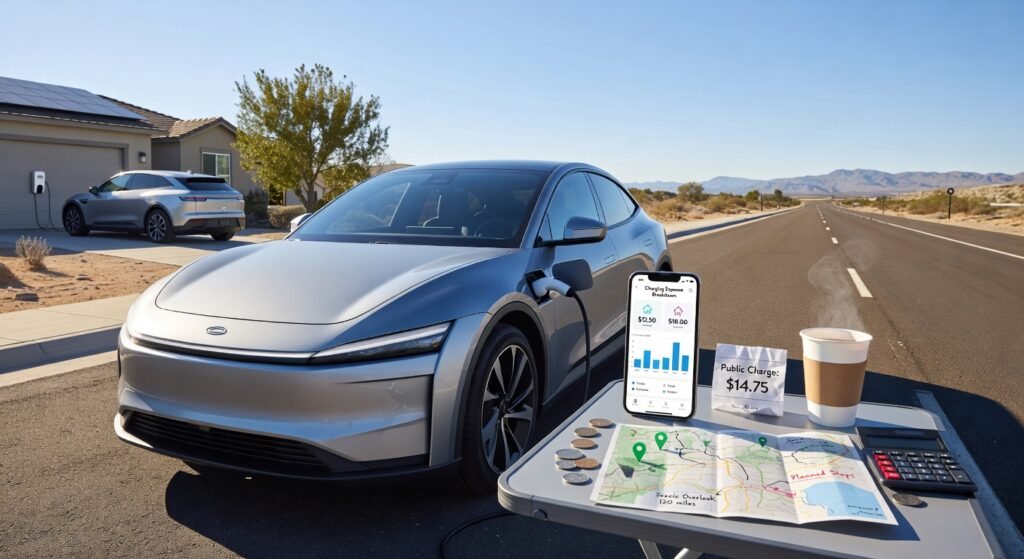
Last summer I packed the car, ignored the gas stations, and drove 2,400 miles across three states in my electric SUV. What started as a fun experiment turned into one of the most eye-opening financial lessons I’ve had in years. The biggest surprise wasn’t that EVs are cheaper. It was exactly how much cheaper—and where the hidden wins kept stacking up.
The Real Cost of Charging vs. Filling Up
On that single trip I spent $87 on electricity. Had I driven the same route in my old gasoline SUV, the fuel cost would have been roughly $310. That’s a $223 difference on one trip. Scale that across multiple journeys per year and the math becomes impossible to ignore.
The Coltura EV vs Gas Calculator confirms what I experienced in real life: even when you factor in every variable, EVs deliver dramatic savings for road trippers. The gap is especially wide on longer drives where you benefit from lower per-mile electricity rates compared to volatile gasoline prices.
Home Charging: Your Secret Money Printer
The real game-changer is home charging. I topped off every night at my hotel or Airbnb using their 120V outlet or a borrowed Level 2 charger. Cost per full charge: between $6 and $14. Compare that to $45–$65 to fill a gas tank and the advantage becomes ridiculous.
Even better, many hotels now offer free EV charging as a perk. I stayed at three different properties that let me plug in overnight at no extra cost. That alone saved me another $40–$50 on the trip. These small wins compound fast.
Public Charging Reality Check
Yes, DC fast chargers are more expensive—often 42–55 cents per kWh versus 12–18 cents at home. But you don’t need them nearly as often as people think. With decent trip planning I only used fast chargers four times during the entire 2,400 miles. The rest was efficient Level 2 or overnight trickle charging.
The trick is treating public charging like you treat gas stations in unfamiliar cities: convenient but not your default strategy. Use apps to find the cheapest stations and charge while you eat, explore, or sleep.
Money-Saving Hacks That Actually Work
I discovered several tactics that most first-time EV road trippers miss:
- Charge during off-peak hours whenever possible
- Join charging network membership programs for lower per-kWh rates
- Use destination chargers at malls, wineries, and museums (often free or very cheap)
- precondition your battery while still plugged in to maximize efficiency
- Track every session in a simple spreadsheet—you’ll quickly see patterns that save hundreds
One unexpected win: my insurance company offered a small discount once I proved I was driving an EV for a significant percentage of miles. Another came from state tax credits I hadn’t even considered when I bought the vehicle.
The Hidden Wins Nobody Talks About
Beyond the direct fuel savings, EV road tripping delivers several financial stealth advantages. No more expensive oil changes every 5,000 miles. Dramatically lower brake wear thanks to regenerative braking. And perhaps most importantly, the ability to charge while you do literally anything else—turning “refueling time” into productive or enjoyable time.
The environmental upside feels even better when you realize you’re not sacrificing your budget to get it. In fact, you’re coming out ahead.
The road trip proved what the numbers had been hinting at all along: switching to electric isn’t just responsible. For anyone who drives more than a few thousand miles per year, it’s becoming the fiscally superior choice.
I’m already planning next summer’s route. This time I’m going farther.
Other EV Articles
- The EV Market is Splitting in Two – And That’s Actually Great News
- Why the Trump-Xi Summit Just Made Chinese EV Market Access a Much Bigger Problem
- QuantumScape’s $11M Q1 Billings: Why the Eagle Battery Just Changed the Game

- Toyota’s bZ4X Just Took the EV Crown – What It Really Means for the Future
- Uber’s $1.25 Billion Bet on Rivian Just Changed the Robotaxi Race

- Tesla’s Cybercab Production Just Started — And It Changes Everything
- Mitsubishi and Škoda Just Dropped Two Very Different EV Bombshells for 2026
- Kia’s Bold EV3 Gamble: Why This Compact SUV Could Redefine Affordable Electric Driving
- Lexus Just Dropped a Three-Row Electric SUV That Feels Like a Private Jet on Wheels
- Tesla’s Spring 2026 Update Just Changed the Game: Hey Grok and Smarter FSD Are Here
- Sony Honda Afeela 1: Why This Premium EV Could Redefine What “Luxury” Means in 2026
- Jeep’s 2026 Recon EV: The Wrangler’s Electric Twin That Might Actually Deliver Off-Road Fun

- Hino’s New LE Series Electric Truck Just Changed the Medium-Duty Game
- Why Polestar’s OEM Telematics Just Got a Whole Lot Smarter with Geotab

- BYD Just Overtook Tesla as the UK’s Top EV Brand – What This Really Means

Leave a Reply