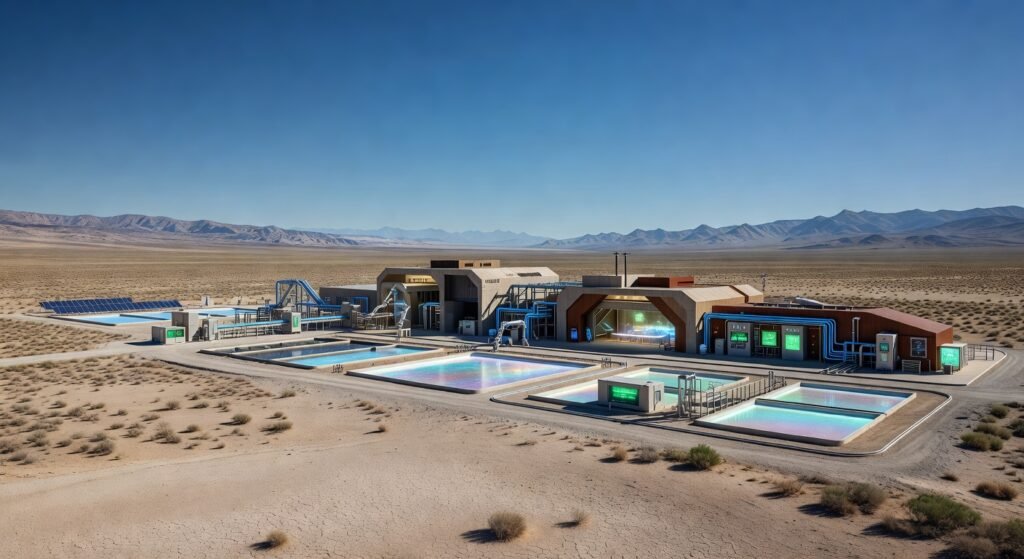
The race to electrify transportation has a dirty little secret: America still imports nearly all of its battery-grade lithium. That dependence is about to face its biggest challenge yet. Century Lithium’s Angel Island project in Nevada isn’t just another mine — it’s a legitimate shot at building a secure, domestic lithium supply chain right in the heart of the American West.
For years, the EV boom has been powered by foreign refining, mostly from Australia, Chile, and China. While politicians talk about reducing reliance on overseas supply, few projects have reached the scale and technical maturity needed to actually move the needle. Angel Island stands out because it combines three rare advantages: massive scale, a cleaner processing method, and a location that makes economic and strategic sense.
A Domestic Lithium Giant in the Making
Located in the Clayton Valley, the Angel Island project holds one of the largest known lithium resources in the United States. What makes it different isn’t just the size of the deposit. Century Lithium has developed a flowsheet that uses saltwater instead of sulfuric acid for much of the processing. That single change dramatically reduces environmental impact while keeping costs competitive.
This matters to the environmentally aware yet fiscally responsible crowd because it proves you don’t have to choose between green goals and economic reality. Lower chemical use means less waste, lower water consumption in a desert region, and a faster path through permitting. In an industry where most projects die in regulatory purgatory, that’s a serious advantage.
Why This Breakthrough Feels Different
The timing couldn’t be more critical. With the Inflation Reduction Act pushing hard for North American battery materials, automakers and battery manufacturers are desperate for traceable, domestic lithium. Angel Island isn’t promising production in some distant future. Recent pilot testing has already produced battery-grade lithium carbonate, proving the process works at scale.
What’s surprising is how quietly this has been progressing while the media chases flashier EV startups. Century Lithium has been methodically de-risking the project — something seasoned investors respect far more than hype. The company’s approach feels refreshingly old-school: prove the resource, prove the metallurgy, then scale.
The Strategic Ripple Effects
Success here would do more than create jobs in Nevada. It would give American battery makers a reliable alternative to Chinese-dominated supply chains. That matters for national security, for price stability, and for the credibility of the entire EV transition. When your green transportation future depends on materials from countries with opposing interests, the math eventually stops working.
The project also challenges the common narrative that America has already lost the battery materials race. While it’s true we lag in refining capacity, high-quality domestic resources like Angel Island show we still have cards to play. The difference this time is that policy, technology, and market demand are finally lining up.
What Comes Next
The next 12–18 months will be telling. If Century Lithium continues hitting technical and regulatory milestones, Angel Island could become the poster child for a new wave of American critical minerals development. Not because of government mandates alone, but because the fundamentals finally make sense.
For those of us watching the EV revolution closely, this is the kind of story worth paying attention to. It’s not about hype cycles or stock pumps. It’s about whether the energy transition will be built on solid domestic foundations or remain permanently tethered to fragile global supply lines.
The EV revolution needs more than cool cars and big batteries. It needs real, responsible sources of materials. Angel Island isn’t a guaranteed win, but it currently represents one of the most credible chances America has to secure its own lithium future.
Other EV Articles
- The EV Market is Splitting in Two – And That’s Actually Great News

- Why the Trump-Xi Summit Just Made Chinese EV Market Access a Much Bigger Problem
- QuantumScape’s $11M Q1 Billings: Why the Eagle Battery Just Changed the Game

- Toyota’s bZ4X Just Took the EV Crown – What It Really Means for the Future

- Uber’s $1.25 Billion Bet on Rivian Just Changed the Robotaxi Race

- Tesla’s Cybercab Production Just Started — And It Changes Everything

- Mitsubishi and Škoda Just Dropped Two Very Different EV Bombshells for 2026

- Kia’s Bold EV3 Gamble: Why This Compact SUV Could Redefine Affordable Electric Driving
- Lexus Just Dropped a Three-Row Electric SUV That Feels Like a Private Jet on Wheels

- Tesla’s Spring 2026 Update Just Changed the Game: Hey Grok and Smarter FSD Are Here
- Sony Honda Afeela 1: Why This Premium EV Could Redefine What “Luxury” Means in 2026

- Jeep’s 2026 Recon EV: The Wrangler’s Electric Twin That Might Actually Deliver Off-Road Fun

- Hino’s New LE Series Electric Truck Just Changed the Medium-Duty Game
- Why Polestar’s OEM Telematics Just Got a Whole Lot Smarter with Geotab

- BYD Just Overtook Tesla as the UK’s Top EV Brand – What This Really Means


Leave a Reply